Does anesthesia-free teeth cleaning go under the gum line?
Above the gum, below the gum: what the words mean
Two words do most of the work in this debate. Supragingival means the part of the tooth you can see — the crown, above the gum. Subgingival means below the gum line, in the narrow pocket (the sulcus) where the gum hugs the tooth. In a healthy dog, that pocket is about 1–3 millimeters deep.
The two zones do different damage. Tartar above the gum looks bad and sours breath, but the disease that costs dogs their teeth — periodontal disease — starts in the pocket, where plaque bacteria inflame the gum and, left alone, erode the bone anchoring the tooth. By age three, about 80% of dogs already show some form of dental disease (AVMA).
So "do you go under the gum line?" is the right question to ask any awake-cleaning provider. The complete answer has to carry two qualifiers: how far under, and in what kind of mouth.
The four stages of gum disease — and what we can clean awake
Veterinary dentistry grades periodontal disease in four stages. The stage decides whether an awake cleaning is appropriate — not the provider's confidence.
| Stage | What's happening | Can we clean it awake? |
|---|---|---|
| Stage 1 · Gingivitis | Red, inflamed gum edge from plaque and tartar. No bone loss yet. Reversible with cleaning and home care. | Yes. |
| Stage 2 · Early periodontitis | Inflammation plus the beginnings of attachment loss (up to about 25%) at the gum margin. | Yes — with limited subgingival scaling at the margin. |
| Stage 3 · Moderate periodontitis | 25–50% attachment loss. Pockets deepen past what awake instruments can reach. | No — referred to a veterinarian for an anesthetic dental with X-rays. |
| Stage 4 · Advanced periodontitis | More than 50% attachment loss. Loose teeth, likely extractions. | No — referred. |
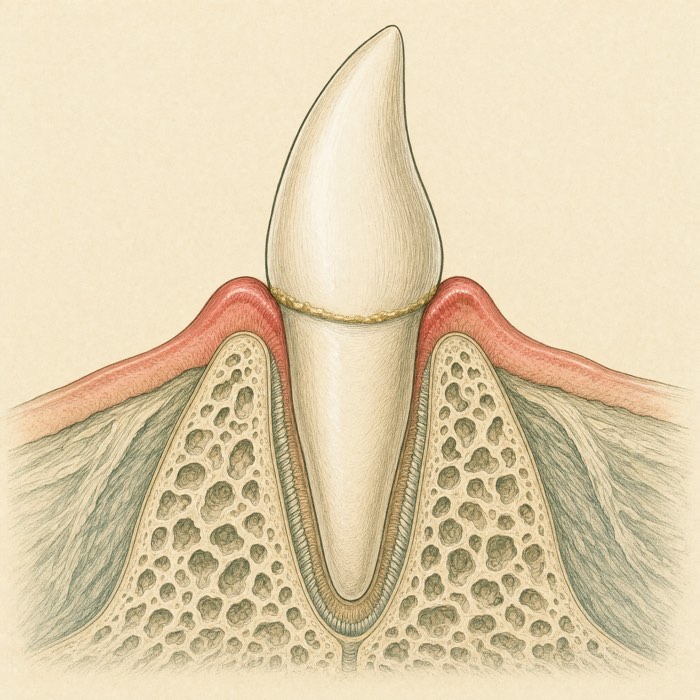
Stage 1
Gingivitis
We clean this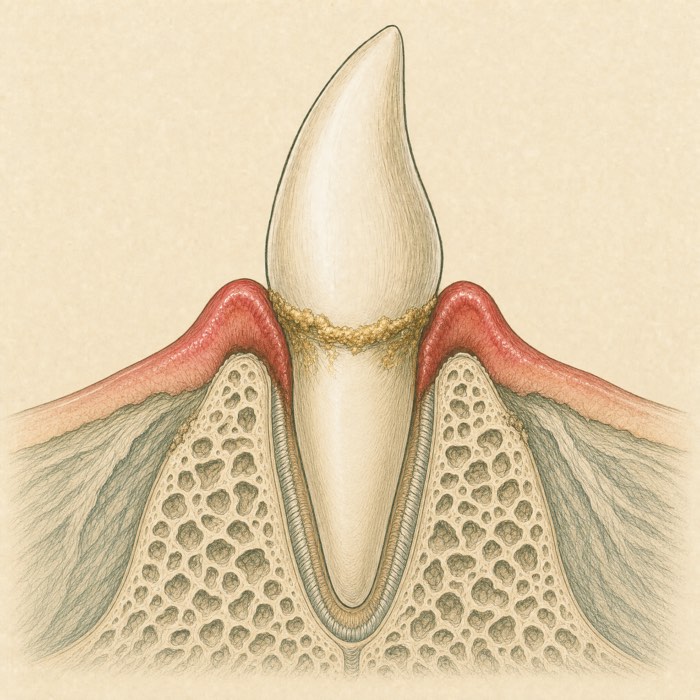
Stage 2
Early periodontitis
We clean this — limited subgingival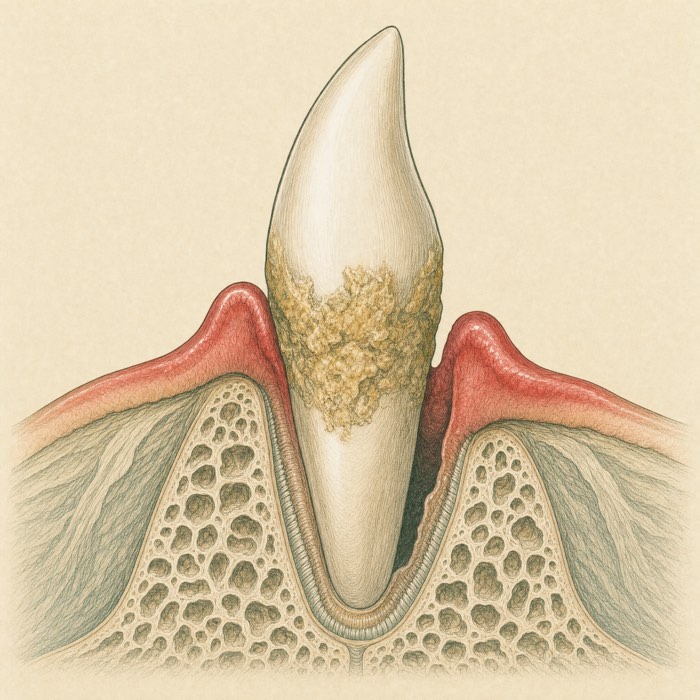
Stage 3
Moderate periodontitis
Referred to your veterinarian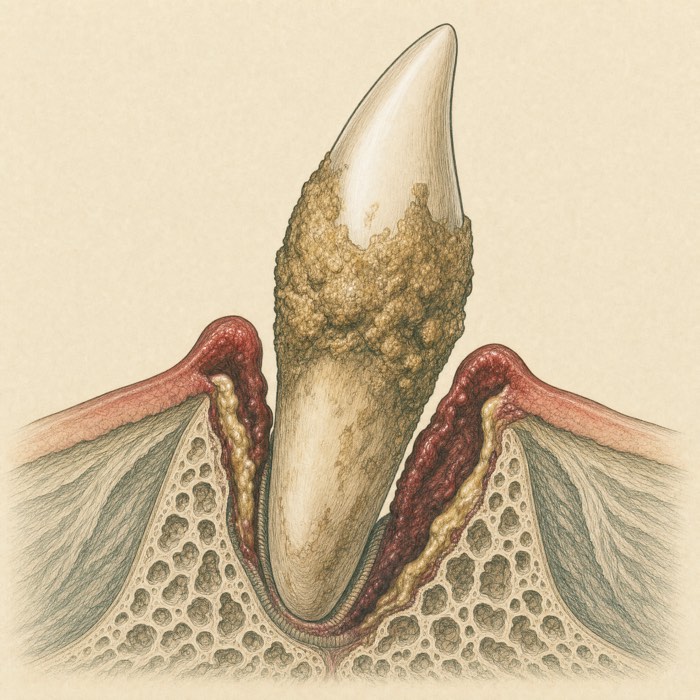
Stage 4
Advanced periodontitis
Referred to your veterinarianIf I open a mouth and see stage 3, the cleaning stops. That pet needs a veterinarian, not me.
Lindsey · Veterinary dental hygienist · 20 years, 1,000+ pets
What "limited subgingival" means at our clinic
In a stage 1–2 mouth, Lindsey scales the visible crown, then works a limited depth below the gum margin — into that shallow, still-healthy pocket — to clear the plaque and tartar sitting where disease starts. She polishes the treated surfaces after scaling. That is as deep as awake dentistry can responsibly go.
The American Veterinary Dental College states that subgingival scaling of every tooth "is impossible in an unanesthetized canine or feline patient," and that removing tartar from only the visible surfaces is "purely cosmetic." We agree with both statements. A dog with 42 teeth and deep, diseased pockets will not hold still for instrument work below the gum on every one of them, and should not be asked to. That is exactly why we do not accept those mouths.
The AVDC also notes that a complete oral exam and dental X-rays are not possible in an awake patient. True again — which is why, at our Orange County location, a licensed DVM examines every pet before Lindsey begins, and anything that needs imaging gets referred out rather than guessed at.
Limited subgingival scaling in an early-stage mouth is maintenance. It is not treatment for periodontal disease, and it is not a substitute for your veterinarian.
Why some providers claim "above and below the gum line" — and what to ask instead
"Above and below the gum line" appears in a lot of anesthesia-free marketing. The phrase is only true with the qualifiers attached: below the gum a limited depth, in a mouth healthy enough for it. Stated without qualifiers, it implies the full subgingival cleaning of an anesthetic dental — which no awake provider can deliver.
Three questions separate a disciplined provider from an overseller:
- Which stages of gum disease do you accept? The defensible answer is stage 1–2 only. We publish our refusal list in the pets we turn away.
- What happens if you find worse disease mid-cleaning? The right answer is that the cleaning stops and you get a referral — not a cosmetic scrape over a diseased mouth.
- Is a veterinarian involved? In California this is not optional. State regulation (16 CCR §2037, in force since 2012) requires a licensed veterinarian to examine the pet first and directly supervise any anesthesia-free scaling. Unsupervised cleanings by groomers or laypeople are unlicensed veterinary practice.
The stress-and-safety side of this — sharp instruments, restraint, aspiration risk — gets its own treatment in our guide: Is anesthesia-free dog teeth cleaning safe?
When only an anesthetic dental will do
Some mouths need a veterinarian and an anesthesia machine, full stop. We refer out, without exception: stage 3–4 periodontal disease, loose or fractured teeth, signs of infection or abscess, oral masses, cats with suspected tooth resorption, and any pet too stressed to continue. A light calming aid is part of every visit here as a welfare standard — we send exact instructions after you book — and if a pet stays anxious anyway, Lindsey stops rather than force it.
An anesthetic dental buys what awake cleaning cannot: full-mouth X-rays, probing of every pocket, deep subgingival work, and extractions. AAHA's 2019 dental guidelines call anesthesia-free dentistry "not appropriate because of patient stress, injury, risk of aspiration, and lack of diagnostic capabilities," and the AVMA's policy is that probing, radiography, scaling, and extraction should be performed under anesthesia. For the diseased mouths those positions have in mind, they are right. Modern anesthesia is also safer than its reputation — overall death risk in dogs is under 0.2% (UK CEPSAF study).
If your pet's mouth is past stage 2, book the anesthetic dental. Referring those pets out is not a reluctant concession — it is the protocol. For what both options run in Orange County, see what it costs.
Common questions
How deep can you clean under the gum without anesthesia?+
A limited depth at the gum margin — the shallow pocket of a healthy or early-stage mouth, which in dogs is roughly 1–3 millimeters. That is enough for stage 1–2 gum disease, where the problem sits at the margin. It is not enough for stage 3–4 disease, where pockets deepen beyond what any awake cleaning can reach. Those pets need an anesthetic dental with X-rays, and we refer them to a veterinarian.
What happens if you find stage 3 disease during a cleaning?+
The cleaning stops. Lindsey will not keep scaling a mouth she cannot treat properly awake — a surface-cleaned stage 3 mouth looks better and is still diseased underneath. You get a plain explanation of what she found and a referral to a veterinarian for an anesthetic dental with X-rays. At our Orange County location, a licensed DVM examines every pet before the cleaning starts, so stage 3–4 mouths are almost always caught at the exam — where, if your pet is not a candidate, you pay only the $29 exam fee, not the cleaning price.
Does scaling without polishing damage the enamel?+
Scaling leaves microscopic grooves on the tooth surface, and unpolished grooves give plaque a faster grip. That is a fair criticism of cosmetic-only scraping, and the AVDC makes it. It is also why polishing is part of every cleaning here: after scaling, Lindsey polishes the treated surfaces smooth — the same finishing step used in anesthetic dentals and human dental cleanings. A provider who scrapes visible tartar and skips the polish leaves teeth that look white and collect plaque faster than before.